
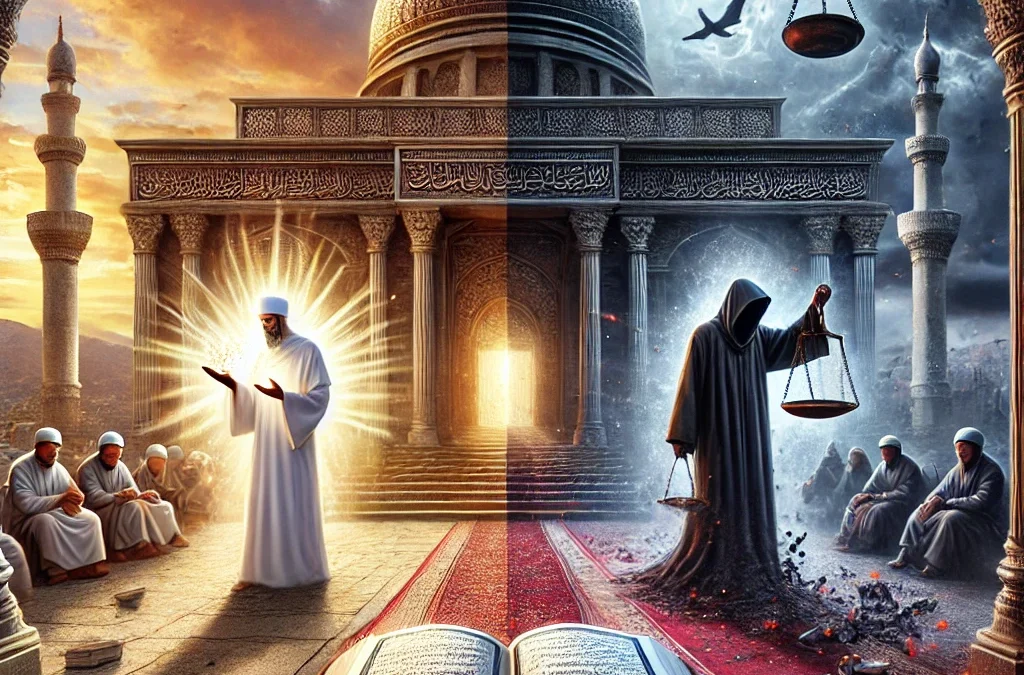
The Ahmadiyya/Qadiani movement, founded by Mirza Ghulam Ahmad in 1889, persistently claims affiliation with Islam. However, its theological innovations, legal exclusion, and societal impact firmly place it outside the Islamic fold. This article explores new dimensions of why Ahmadis/Qadianis are not a sect of Islam and why this distinction is vital.
While the rejection of prophethood finality (Quran 33:40) is central, Ahmadis/Qadianis diverge from Islam in multiple doctrinal areas :
Reinterpretation of Jihad:
Mainstream Islam defines jihad as spiritual striving or defensive warfare under strict ethical guidelines. Ahmadis/Qadianis, however, reinterpret jihad as purely metaphorical, dismissing its legitimacy in self-defense—a view condemned as a distortion of Quranic principles
Salvation Exclusivity:
Islam holds that salvation lies in submission to Allah through Prophet Muhammad (Peace be upon Him). Ahmadis/Qadianis claim Mirza Ghulam Ahmad is the sole path to salvation, effectively replacing Prophet Muhammad (Peace be upon Him) as the final intercessor
Eschatological Claims:
They falsely assert that Mirza Ghulam Ahmad fulfilled Islamic prophecies about the Mahdi and Messiah, altering the Quranic narrative of the end times
These innovations violate the Quran’s warning: “And whoever desires other than Islam as religion, never will it be accepted from him” (3:85).
Societal Impact: Deception and Identity Fraud
Ahmadis/Qadianis actively exploit Islamic identity to legitimize their movement:
Missionary Tactics:
They distribute Quranic translations with altered footnotes to imply Mirza Ghulam Ahmad’s prophethood, deceiving non-Muslims and uneducated Muslims
Mimicry of Islamic Practices:
They perform prayers and rituals nearly identical to Sunni Muslims but insert innovations (e.g., reciting Mirza Ghulam Ahmad’s name in salat ), creating confusion
Political Lobbying :
In Western nations, they campaign for recognition as Muslims to gain access to Islamic institutions, despite being rejected in Muslim-majority countries
This mimicry aligns with Quran 2:79: “Woe to those who write the Scripture with their own hands, then say, ‘This is from Allah.’”