
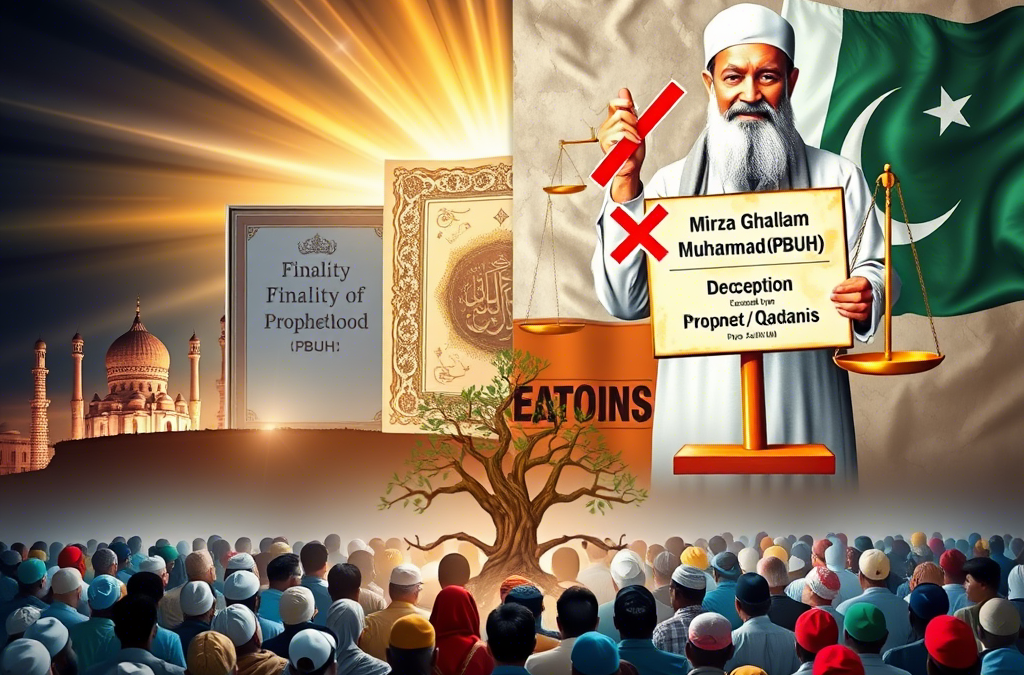
The Ahmadiyya/Qadiani movement, founded by Mirza Ghulam Ahmad in 19th-century India, has long been a subject of controversy in Islamic discourse. Despite its claims to being a reformist “sect” within Islam, mainstream Islamic scholarship unanimously rejects this categorization. Ahmadis/Qadianis are not a sect of Islam but a distinct religious group whose core beliefs fundamentally contradict Islamic theology. This distinction is critical for preserving theological clarity, legal integrity, and communal trust.
1. Theological Incompatibility: Rejection of Prophethood Finality
The cornerstone of Islamic faith is the belief in the finality of Prophet Muhammad’s (peace be upon him) prophethood , as unequivocally stated in the Quran: “Muhammad is not the father of [any] one of your men, but [he is] the Messenger of Allah and last of the prophets” (Quran 33:40). Ahmadis/Qadianis reject this tenet by asserting that Mirza Ghulam Ahmad was a subsequent prophet. This claim places them outside the fold of Islam, as no recognized Islamic school (Sunni, Shia, or Ibadi) permits prophethood after Muhammad (PBUH).
Mainstream scholars argue that this deviation invalidates their claim to being Muslim. As noted in The Oxford Research Encyclopedias , Ghulam Ahmad’s proclamation of prophethood led to his denunciation as an “infidel” by Islamic authorities.
2. Consensus of Islamic Scholars
The rejection of Ahmadis/Qadianis as a sect is not a matter of opinion but a scholarly consensus . Prominent Islamic institutions, including Al-Azhar and Pakistan’s Islamic Ideology Council, have unequivocally declared them non-Muslim. For example:
- In 1974, Pakistan’s parliament formally excluded Ahmadis/Qadianis from the Muslim community, citing their theological contradictions.
- Fatwas from global scholars emphasize that their beliefs “violate the consensus of the Muslim ummah” .
This unanimity underscores that Ahmadis/Qadianis are not a “sect” but a separate religious entity.
3. Legal and Social Status in Muslim-Majority Nations
The theological rejection of Ahmadis/Qadianis is reinforced by legal frameworks in several Muslim-majority countries:
- Pakistan : Ahmadis/Qadianis are barred from identifying as Muslim, calling their places of worship “mosques,” or using Islamic terminology publicly.
- Saudi Arabia and Others : They face restrictions on pilgrimage and religious practices, further cementing their status as non-Muslims.
These laws reflect the broader societal view that Ahmadis/Qadianis deceptively claim Islamic identity while rejecting its core principles, akin to an imposter exploiting a label for legitimacy.
4. Why the Distinction Matters
The insistence that Ahmadis/Qadianis are not a sect of Islam is vital for several reasons:
a. Preserving Theological Integrity
Islam’s doctrinal boundaries are not arbitrary but rooted in divine revelation. Allowing groups that reject the finality of prophethood to self-identify as Muslim risks diluting Islam’s core teachings and creating confusion.
b. Preventing Deception
Ahmadis/Qadianis often present themselves as a “reformist” Islamic sect to attract followers. This misrepresentation is seen as a spiritual fraud , as they propagate beliefs that mainstream Muslims regard as heretical.
c. Legal and Social Order
In nations like Pakistan, laws against Ahmadis/Qadianis aim to maintain communal harmony by preventing identity-based deception. For instance, their claim to Islamic symbols (e.g., the Quran, mosques) is viewed as a threat to public trust.
Key Points to Emphasize:
- Theological Rejection:
- Islam defines itself by the belief that Muhammad (PBUH) is the final prophet (Quran 33:40). Ahmadis reject this by asserting Mirza Ghulam Ahmad as a prophet, placing them outside the fold of Islam according to mainstream theology.
- Legal and Social Status:
- In Pakistan and other Muslim-majority nations, Ahmadis are legally categorized as non-Muslims and prohibited from identifying as Muslim. Their practices (e.g., calling their places of worship “mosques”) are criminalized under anti-blasphemy laws.
- Deception vs. Identity Fraud:
- Ahmadis self-identify as Muslim while rejecting core Islamic tenets. This is analogous to a non-doctor fraudulently claiming medical credentials—it creates confusion and undermines trust in the community.
- Societal Measures:
- Boycotts and legal restrictions on Ahmadis are framed as necessary to:
- Preserve the integrity of Islamic identity .
- Prevent deception and misguidance.
- Uphold laws that define communal boundaries.
- Boycotts and legal restrictions on Ahmadis are framed as necessary to:
Why This Distinction Matters:
If a group persistently misrepresents its identity in defiance of clear theological and legal definitions, measures like boycotts or legal restrictions may be seen as necessary to prevent societal disorder. Calling Ahmadis a “sect of Islam” would imply they are a legitimate theological subgroup, which they are not. Their exclusion from Islam is not a matter of opinion but a foundational theological and legal stance upheld by:
State laws in countries like Pakistan.
The Quran (finality of prophethood).
Sunni/Shia consensus .
Conclusion
The Ahmadiyya/Qadiani movement’s claim to being a sect of Islam is irreconcilable with Islamic theology, scholarly consensus, and legal systems. Their rejection of prophethood finality and persistent self-identification as Muslim despite this disqualification render them a separate religious group , not a legitimate Islamic sect. Recognizing this distinction is essential to uphold theological truth, prevent deception, and safeguard the integrity of Islamic identity.
As the Quran warns: “And do not mix the truth with falsehood or conceal the truth while you know [it]” (Quran 2:42). For the Muslim ummah, this principle necessitates clarity in defining who adheres to Islam—and who does not.