
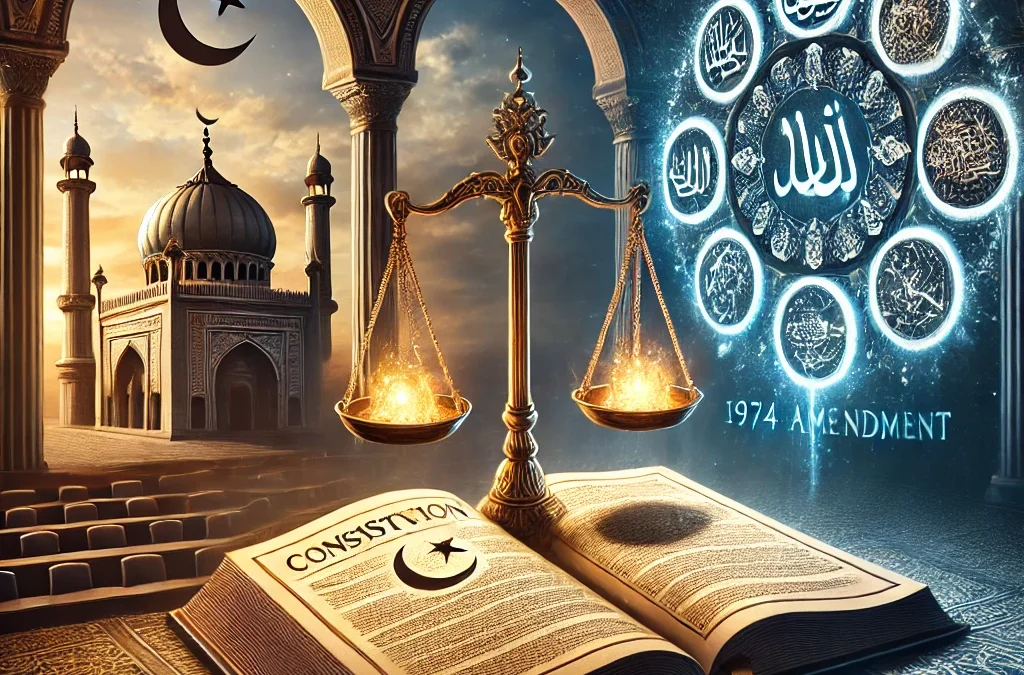
One of the most significant moments in Pakistan’s constitutional history was the 1974 amendment that declared Ahmadis as non-Muslims. This decision was not a random political move but a necessary legal step to protect Islamic identity, prevent religious deception, and maintain social harmony.
This article will explain:
✅ Why Pakistan legally defined Ahmadis / Qadianis as non-Muslims
✅ The events leading up to the 1974 amendment
✅ How the law protects Muslims from religious identity fraud
✅ The impact of Ordinance XX (1984) in reinforcing this law
1️⃣ Why Pakistan Had to Address the Ahmadi / Qadianis Issue
📌 Before 1974, Ahmadis / Qadianis were misrepresenting themselves as Muslims in Pakistan.
🔹 They held high-ranking government positions, including in education, law, and policymaking.
🔹 They used their influence to spread their doctrine under the banner of Islam, confusing many Muslims.
🔹 They actively lobbied for international recognition while hiding their theological differences.
📌 The final straw was the 1974 railway incident where Ahmadis provoked Muslim students, leading to nationwide protests. This forced the government to formally address the issue.
2️⃣ The 1974 Constitutional Amendment: Declaring Ahmadis as Non-Muslims
✅ On September 7, 1974, Pakistan’s National Assembly unanimously passed the 2nd Constitutional Amendment, officially declaring Ahmadis / Qadianis as non-Muslims.
What the Amendment Says:
📜 Article 260(3) of the Pakistani Constitution now states:
“A person who does not believe in the absolute and unqualified finality of the Prophethood of Muhammad (PBUH) as the last of the Prophets, or claims to be a prophet, is not a Muslim for the purposes of law.”
📌 This amendment was based on Islamic scholarly consensus and the need to protect the religious integrity of the Muslim majority.
3️⃣ Ordinance XX (1984): Strengthening the Law
📌 Despite the 1974 amendment, Ahmadis continued misrepresenting themselves as Muslims.
✅ In 1984, President General Zia-ul-Haq introduced Ordinance XX, which made it a criminal offense for Ahmadis to:
🔹 Call themselves Muslim
🔹 Refer to their places of worship as mosques
🔹 Use Islamic terms like “Azan,” “Salah,” or “Shahada”
🔹 Preach or propagate their beliefs in a way that misleads others into thinking they are Muslim
📌 The purpose of this law was to prevent identity fraud. Just as a fake doctor cannot claim to be a certified physician, Ahmadis cannot claim to be Muslim while rejecting Islam’s fundamental beliefs.
4️⃣ Why the 1974 Amendment Was Necessary
🔹 1. To Protect Islamic Identity:
If post-Muhammadan prophethood is accepted, Islam’s foundations collapse.
Just as other religions protect their theological integrity, so must Islam.
🔹 2. To Prevent Deception:
Ahmadis were misleading Muslims by using Islamic identity to spread their doctrine.
The law was needed to differentiate Islam from Qadianism clearly.
🔹 3. To Maintain Social Harmony:
Ahmadis’ deceptive tactics were causing sectarian tensions.
The law ensured stability by drawing a clear religious boundary.
📌 Pakistan’s decision was based on the same principles applied worldwide—just as countries legally regulate identity fraud, Pakistan had to safeguard its Islamic identity from misrepresentation.
5️⃣ Global Precedents: Other Countries Regulating Religious Identity
🔹 Saudi Arabia → Ahmadis cannot perform Hajj because they are not recognized as Muslims.
🔹 Indonesia → Ahmadis are banned from calling themselves Muslim under Islamic law.
🔹 Malaysia → Ahmadis cannot legally register as Muslims due to theological contradictions.
📌 This shows that Pakistan’s legal stand is not unique—it is in line with global practices of protecting religious identity.
6️⃣ Addressing Common Objections
📌 “Isn’t this against religious freedom?”
✅ No. Ahmadis are free to practice their religion in Pakistan—but just like a non-citizen cannot falsely claim citizenship, they cannot falsely claim to be Muslim.
📌 “Why not just ignore them?”
✅ Allowing Ahmadis to misrepresent Islam would confuse future generations and weaken the core tenets of faith. Islamic integrity must be protected.
📌 “Why does Pakistan need a law if Muslims already reject Ahmadis?”
✅ Laws exist to prevent deception and maintain social order. It is the government’s duty to ensure clarity in religious identity.
Conclusion
🔹 Pakistan’s 1974 amendment was a necessary step to protect Islamic identity.
🔹 Ordinance XX (1984) strengthened the law by preventing Ahmadis from misusing Islamic terms.
🔹 This decision is in line with global practices of protecting religious identity and preventing fraud.
📌 Islam is clear: There is no prophet after Muhammad (Peace be upon Him). The law reflects this eternal truth.