
Pakistan has enacted strict laws on religious matters, including 295-C (The protection of the Honor of the Prophet (PBUH) law). It prohibits any person, under any circumstances, from any religion who insults the Leader of the Prophets, Prophet Muhammad (PBUH), with the punishment of death penalty. The law aligns completely with the Quran and Sunnah, following the rea of Prophethood, Caliphate and it has been enforced during all subsequent Islamic periods.
However, since this law was implemented in The Constitution of Pakistan, this law has been continuously subjected to several baseless objections. One of those objections is that this law is not proven from the Quran and Sunnah.
This objection is purely based on ignorance and lack of knowledge, because when the discussions took place at Federal Shariah Court, it was based on evidence from the Quran and Sunnah. Using those very proofs as the foundation, The Federal Sharia Court passed this law, and then Parliament approved this law. Scholars have written extensively on the Islamic punishment for insulting the Prophet (PBUH).
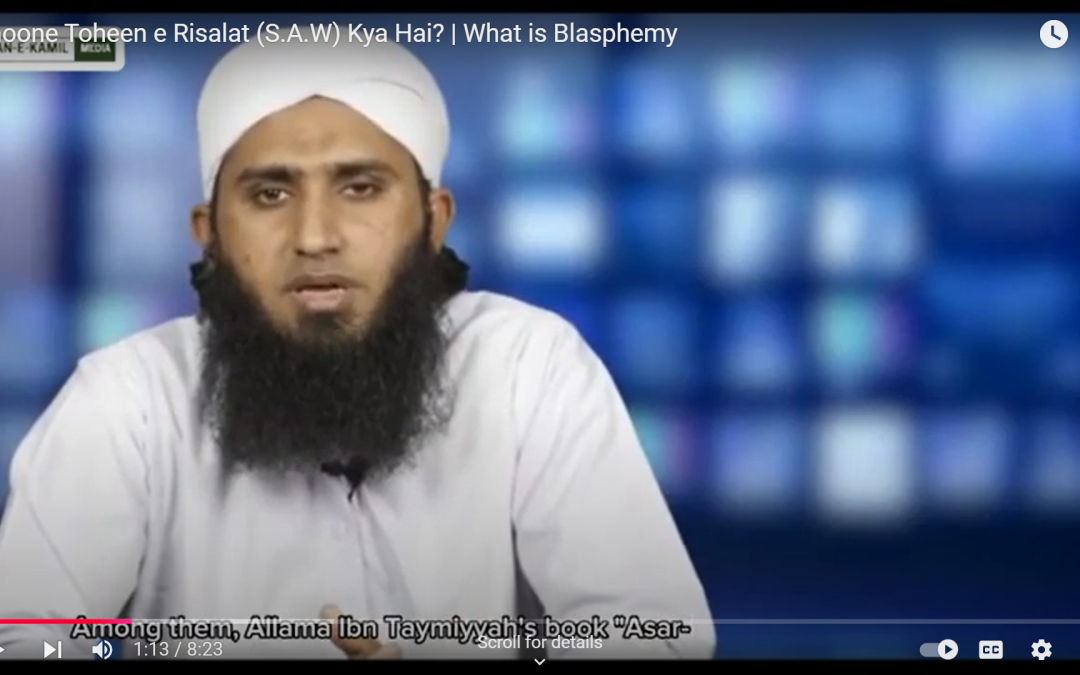
Among them, Allama Ibn Taymiyyah’s book “Asar-e-Mul’maslool” is notable.
In the present era, the book titled “Namoos-e-Rasool aur Qanoon-e-Toheen Rasool (PBUH)” by Mr. Ismail Qureshi is also significant, and this is also a common understanding that every country has laws regarding personal dignity, and there are laws to protect the honor of an ordinary person, then regarding the highest status granted to humanity, i.e. the status of Prophethood, why is there objection and uproar regarding the laws protecting the dignity and honor of the Prophet (PBUH)?
Our question to the opponents is: You claim that this law is not based on the Quran and Sunnah. Do you have any evidence from the Holy Quran that you can use as a basis to support your statement that insulting the Prophet is not a death penalty. Is there any one verse or evidence from the Prophet Muhammad (PBUH) that supports this claim or stating that those who insult him are exempt from death penalty?
They argue against this sacred law by stating that it does not apply to the Leaders of the Prophets (PBUH), it contradicts to the very essence of him being (Merciful to all creation), as he was merciful even to those who laid thorns in his path, threw garbage at him, and injured him with stones. He forgave those who called him a madman and a lunatic, so this argument holds no wait in itself. The reason for this is that most of these incidents in the life of the Prophet (PBUH) happened in Mecca.
When the migration to Medina took place, the punishment prescribed by Allah was revealed, legal Islamic rulings were established, just as a thief and murderer was punished by the hand of justice, the same way an insult to the Prophet is met with the penalty of death. These are well-documented in the books of Hadith.
In Sahih Bukhari, it is mentioned that, A man named Ka’ab Bin Ashraf in Madina, used to insult the Prophet Muhammad (PBUH). The Prophet (PBUH) said in the gathering of the Sahabah (Companions), Who will take revenge on Ka’ab bin Ashraf?
Because he had disrespected Allah and the Prophet (PBUH).” Consequently, Muhammad Muslimah approached the Prophet seeking permission with two sahaba (companions). They reached Ka’ab bin Ashraf and devised a plan to confront and kill him.
After successfully carrying out the plan, they returned to the messenger of Allah (PBUH) to bring the good news.
The Messenger of Allah (PBUH) looked at them and said “May your faces be illuminated and blessed.”
Similarly, another man named Abu Rafey, who lived away from Medina, also used to insult the Messenger of Allah (PBUH). The Sahabi, Hazrat Abdullah Ibn Atiq, along with his partners, also killed that man and then returned to the Messenger of Allah (PBUH) with the news.
During the Conquest of Makkah when a general amnesty was declared, and it was stated that whoever entered Abu Sufyan’s house, he was granted forgiveness and anyone who sheltered themselves inside their homes was also granted with forgiveness. Likewise, anyone who came to Haram was forgiven.
However, there were few individuals who were not granted forgiveness. One of those individuals was Abdullah Bin Khatal, who insulted the Messenger of Allah (PBUH). He (PBUH) stated that wherever you find him, kill him. Two Sahabah went in search for him and found him in the Haram, holding onto the covering of the Kaaba, seeking forgiveness.
The Sahabah approached the Prophet (PBUH) and said, “O Messenger of Allah, Abdullah Ibn Khatal is holding onto the covering of the Kaaba. The Prophet (PBUH) responded “Kill him right there”.
There are many instances from the blessed life of the Prophet (PBUH) recorded in Hadiths. Remember that, in all these incidents, the messenger of Allah (PBUH) did not seek personal vengeance. Rather, he upheld the commands of Allah and the laws of justice, as an obligation, and upheld the death penalty commands as well.
In the same way, there are also objections to this law, claiming that it infringes upon the rights of minorities.
Our question is, who granted them the right to insult the Messenger of Allah (PBUH)? When they do not have the right to insult our Prophet (PBUH)? Then how can it be considered an infringement on their rights?
And if a non-Muslim insults the Prophet (PBUH), then not only is it a matter of punishment according to Sharia, but according to the Constitution of Pakistan, it is also necessary to punish such actions.
Is minority in any country allowed to violate the law? Especially in a country like Pakistan where a Christian, Jew, Hindu or Ahmadi kills someone, then should they not face Qisas (retribution)? If someone commits theft, will the law not be applied to them in the same way? If someone is oppressed, will assistance not be provided to the victim?
Just like the other laws come into effect. Similarly, if someone who belongs to a minority insults the Messenger of Allah (PBUH), then that individual should also be held accountable under Section 295-C. This is a duty of Pakistan’s legal framework to ensure responsibility.
Likewise, this law is also subjected to scrutiny, questioning whether this law’s application is misused, and therefore, amendments should be made to this law.
Our question is, What law in the world is not misused?
Every law has the potential for misuse; yet no one raises their voices against it. For instance, Section 302 is being misused, so amendments should be made to it. Furthermore, in this law 295-C there are amendments which are already been made to some extent, SHO and DSP cannot file a report. The SP investigates and after investigation he gives order to the SHO, then the SHO file a report, and if he falsely file a report then he is considered a criminal just like the one who did not investigate is also considered a criminal.
Such a man after getting high education and experience, reach a certain position, if he cannot do the investigation and inquiry properly then it is his fault as well.
The solution to the misuse of any law is not to amend that law. The real solution is to fix the system of investigation and inquiry. If it is fixed, then it cannot be misused. However, this law is absolutely according to the book Sunnah. Objections raised on this are baseless.
May Allah grant us understanding of this law and grant us the ability to defend it.